
A Family Member Passed Away Leaving Debts Behind (Renunciation of Inheritance)
Inheritance


- Yaizu & Makinohara Attorneys Top
- Inheritance
- A Family Member Passed Away Leaving Debts Behind (Renunciation of Inheritance)
- I want to consult about inheritance in Yaizu/Makinohara
- I received a demand for my deceased father's debts
- My father passed away leaving debts behind — do I have to pay them?
Are you facing any of these issues in Yaizu, Makinohara, Omaezaki, Fujieda, Shimada, Yoshida Town, or other nearby areas?
At Yaizu Sogo Law Office, we offer a free first-time legal consultation on inheritance and estate matters. Consulting us once does not obligate you to retain us. We are also available on weekday evenings and on Saturdays. Please feel free to contact us by phone or email.
Heirs Inherit Not Only Positive Assets but Also Negative Assets (Debts)

When a succession occurs, heirs inherit not only positive assets such as bank deposits and real estate, but also negative assets such as debts.
It would be ideal if every decedent left only positive assets, but unfortunately, many people pass away leaving behind substantial debts.
In such cases, by renouncing the inheritance, you can be released from liability for the decedent's debts. This article explains the renunciation of inheritance.
Typical Examples of Inheriting Debts
- Auto loans
- Mortgage loans (where group credit life insurance does not apply)
- Consumer finance borrowings
- Tax arrears (resident tax, property tax, national health insurance premiums, etc.)
- Joint and several guarantee obligations
- Unpaid amounts under various contracts
→ Even if you think "I am not a guarantor, so it has nothing to do with me," please note that all debts of the decedent are inherited.
What Is Renunciation of Inheritance?
Renunciation of inheritance is a declaration by an heir that he or she will not succeed to any of the rights or obligations of the decedent.
In principle, renunciation of inheritance must be filed with the Family Court within three months from the time the heir became aware of the commencement of the succession (Article 915, Paragraph 1 of the Civil Code). Generally, you may consider this to mean from the time of the decedent's death.
If you do not renounce the inheritance within this three-month period, you will inherit all of the decedent's assets (both positive and negative). Please note that, as a rule, renunciation is no longer possible after the three-month period has expired.
Renunciation of inheritance is filed with the Family Court that has jurisdiction over the decedent's last domicile. Specifically, you must prepare the necessary documents (family register transcripts, etc.) and submit a petition for renunciation. It is not necessary for all heirs to file together — a single heir may renounce independently.
Once the renunciation is accepted, the renouncing heir is treated as if he or she had never been an heir from the beginning (Article 939 of the Civil Code). As a result, the renouncing heir is released from the obligation to repay the decedent's debts.
Cases Where Renunciation Is Effective
- Debts clearly exceed assets
- There are virtually no assets
- The heir was estranged and the financial situation is unknown
- Concerns about inheritance tax or delinquent taxes
- Unwillingness to assume the debts of a family business
- Unwillingness to succeed to joint and several guarantee obligations
Cases Where Renunciation Is "Especially Important"
- A parent who ran a business has passed away
- There are borrowings from consumer finance companies or multiple lenders
- There are large amounts of delinquent taxes
- A sibling has taken on debts without authorization
→ To reiterate, renunciation of inheritance does not need to be done by all heirs together. Therefore, there is absolutely no problem with renouncing on your own.
Cases Where Renunciation Is Not Permitted
Regardless of whether it occurs before or after renunciation, if certain acts are performed, the renunciation may not be accepted.
For example, if you dispose of all or part of the inherited property before renouncing, or if you conceal all or part of the inherited property, use it for your own purposes, or intentionally omit it from the property inventory, you will be deemed to have accepted the inheritance, and renunciation will no longer be possible.
On the other hand, disposing of items with no financial value (discarding garbage, cleaning up, distributing keepsakes), acts of preservation (acts to maintain the value of the property), paying funeral expenses or unpaid medical bills from the inherited property, or repaying the decedent's debts from the heir's own funds will not be deemed acceptance of the inheritance, so you need not worry.
Acts That Prevent Renunciation (Typical Examples)
- Disposing of inherited property (selling a car, withdrawing deposits, etc.)
- Using inherited property for your own purposes
- Intentionally concealing property, omitting it from the inventory, etc.
Gray Areas That Are Difficult to Judge
- Cleaning out the house (including disposing of items of value)
- Withdrawing more than funeral expenses from the parent's account
- Taking home jewelry intending it as a keepsake
→ These may be viewed as problematic by the court, and professional judgment is required.
Advantages and Disadvantages of Renunciation of Inheritance
The advantage of renunciation of inheritance, as already discussed, is that you will not inherit the decedent's debts and other liabilities.
If the decedent clearly left behind substantial debts, it is strongly advisable to renounce the inheritance.
On the other hand, renouncing the inheritance means that you will also forfeit any positive assets. For example, you will also forfeit real estate such as the decedent's home, making it difficult to continue living there. However, even if you inherit substantial debts in order to keep living in the home, creditors will likely seize the property eventually, so renunciation is still the better option.
Furthermore, there are cases where it is unclear even after investigation whether the decedent's estate is net positive or negative. While it is possible to petition the court for an extension of the renunciation period by explaining the circumstances (e.g., difficulty in investigating the estate), the court will not grant extensions indefinitely. Ultimately, if you cannot bear the risk of inheriting liabilities, renunciation is advisable. (Note: There is also a procedure called "qualified acceptance" (gentei shounin), whereby debts are paid from the inherited property and any surplus is inherited. However, qualified acceptance requires all heirs to file jointly, among other hurdles, so its use is limited.)
Advantages of Renunciation
- No inheritance of debts, delinquent taxes, or loans whatsoever
- Complete release from collection efforts and demands by creditors
- Avoidance of debt-related disputes among siblings
Disadvantages of Renunciation
- Loss of all positive assets as well
- Difficulty continuing to live in the family home
- Possibility that liabilities pass to other heirs
How to Investigate Debts
To decide whether to renounce the inheritance, it is necessary to investigate the existence and amount of debts.
If the full extent of the debts cannot be determined within three months of the decedent's death, it is possible to petition for an extension of the renunciation deadline.
Key Items to Investigate
- Bank loans
- Consumer finance borrowings
- Credit card cash advances
- Unpaid mobile phone bills
- Tax arrears (at the municipal office)
- Unpaid utility bills
- Business loans
- Hospital medical bills
Specific Investigation Methods
- Checking mail and demand notices
- Reviewing bank passbook transaction histories
- Reviewing credit card statements
- Requesting credit information disclosure (as needed)
- Confirming delinquency status at the municipal office
- Interviews with family members and relatives
What If More Than Three Months Have Passed? (Renunciation After Expiration of the Deliberation Period)
In practice, consultations where "three months passed before I knew it" are extremely common.
Major Cases Where Renunciation May Be Allowed Exceptionally
- The heir was completely unaware of the existence of debts
- There were reasonable grounds to believe the estate was net positive
- The property was intentionally concealed from the heir
Points to Note
The Family Court makes strict judgments, so acceptance is not guaranteed.
However, depending on how the evidence is presented, there are many cases where renunciation has been allowed.
Frequently Asked Questions
More than three months have passed since my father's death. Is it too late to renounce the inheritance?
If there are reasonable grounds for having believed that the decedent had no inherited property at all, renunciation may be possible within three months from the time you became aware of all or part of the inherited property. However, this is an exception, and it is not guaranteed to be accepted.
A creditor of my brother, with whom I had lost contact, suddenly demanded that I pay my brother's debts because I am an heir. My brother apparently died two years ago. Can I still renounce the inheritance?
You may renounce the inheritance within three months from the time you became aware that the succession commenced due to your brother's death. The actual time of your brother's death is irrelevant.
I repaid my deceased father's debts because I thought I had to. Is it too late to renounce the inheritance?
If you made the repayment from the inherited property, this constitutes disposal of the inherited property and may be deemed acceptance of the inheritance.
If you made the repayment from your own funds, you may still renounce the inheritance without any problem.
If I renounce the inheritance, will I also lose the right to receive life insurance proceeds?
If you are designated as the beneficiary of the life insurance policy, the insurance proceeds are not part of the inherited property, so you may still receive them even after renouncing the inheritance.
What is qualified acceptance (gentei shounin)?
Qualified acceptance is a procedure whereby debts and other liabilities of the decedent are paid from the inherited property, and any surplus is inherited. If it is unclear whether the decedent's estate is net positive or negative, qualified acceptance has the advantage of limiting debt repayment to the extent of the positive assets. However, since qualified acceptance requires all heirs to file jointly, among other hurdles, it cannot be used when the heirs cannot reach a consensus.
Which is better — renunciation of inheritance or qualified acceptance?
Because qualified acceptance requires the cooperation of all heirs, renunciation is more commonly used in practice.
If I renounce the inheritance, will it cause trouble for my other siblings?
The liabilities pass to the next-in-line heirs, but we can advise on coordination methods.
I don't know how much debt my parent had. Should I renounce the inheritance?
You should investigate before making a decision, but if the risk is significant, renunciation should be considered.
How long does the renunciation procedure take?
It usually takes about one to two months.
For Your Inheritance Concerns, Consult Yaizu Sogo Law Office

Yaizu Sogo Law Office handles a wide range of inheritance-related matters, including the drafting and execution of wills, renunciation of inheritance, division of estate, and claims for reduction of the statutory reserved share (iryubun).
Inheritance disputes are so notorious for the intense emotional conflict they stir up among heirs — hence their nickname, the "inheritance war" — that disputes can drag on for a long time. This is why consulting a lawyer offers significant benefits.
If you are facing an inheritance issue, please feel free to consult us. The first consultation on inheritance matters is free of charge.
At Yaizu Sogo Law Office, consultations are available not only during weekday daytime hours but also on weekday evenings and on Saturdays. Please call or email us first to make an appointment for a legal consultation.
Contact
If you are facing issues with traffic accidents, debt restructuring, or inheritance:You can consult a lawyer for free
At Yaizu General Law Office, free legal consultations are available for those facing traffic accidents, debt restructuring, or inheritance issues. There is no obligation to retain our services after a free consultation. For other areas of law, consultations are available at 5,500 yen (tax included) per 30 minutes. Please do not hesitate to contact us if you need assistance.
Reservation for Legal Consultation / Contact Us


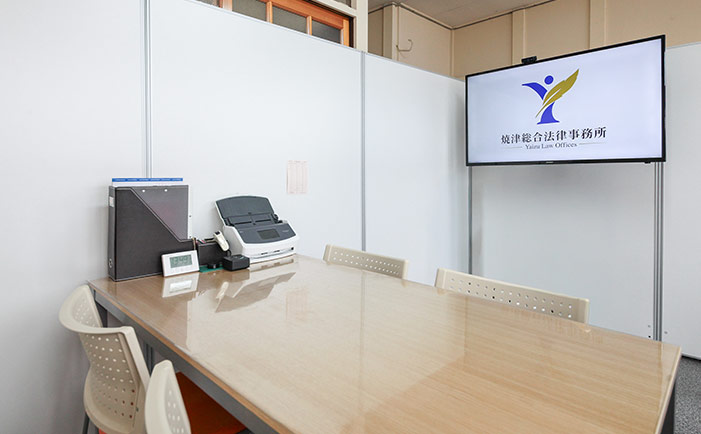
Office
About Yaizu General Law Office
Yaizu Office
-
- Address
- 〒425-0028
3-11-4 Ekikita, Yaizu City,
Shizuoka Prefecture
-
- Phone
- 054-639-5573
-
- Business Hours
- Mon-Fri 9:00 AM - 7:00 PM Sat 9:00 AM - 5:00 PM / Closed: Sundays & Holidays
-
- Access
- 6-minute walk from Yaizu Station / Parking available
- Access
-
- Service Area
- Yaizu, Makinohara, Fujieda, Shimada, Yoshida, and surrounding areas


Makinohara Office
-
- Address
- 〒421-0422
Maison de Hautoku 1F, 140-4 Shizunami,
Makinohara City, Shizuoka Prefecture
-
- Phone
- 0548-28-6710
-
- Business Hours
- Mon-Fri 9:00 AM - 7:00 PM Sat 9:00 AM - 5:00 PM / Closed: Sundays & Holidays
-
- Access
- 4-minute walk from Shizunami 1-chome (Bus Stop) / Parking available
- Access
-
- Service Area
- Yaizu, Makinohara, Fujieda, Shimada, Yoshida, and surrounding areas




Flow
Free Legal Consultation Process
-
01

-
Making a Reservation for Free Legal Consultation
Please make a reservation by phone or email. There is absolutely no obligation to retain our services after a free consultation. If you are in need of help, please feel free to come in for a consultation.
02

-
Free Legal Consultation with an Attorney
An attorney will personally listen to the details of your situation. Bringing a memo or documents summarizing your issue will help the consultation go smoothly. If the matter is resolved through consultation alone, the process ends here.
03

-
If You Wish to Retain an Attorney
During the consultation, we will also explain the fees and outlook should we take on your case. If you wish to proceed, you may retain us at that time. You are also welcome to take the information home and consider it before making a decision.

