
Dividing an Inheritance
Inheritance


- Yaizu & Makinohara Attorneys Top
- Inheritance
- Dividing an Inheritance
- I want to consult about inheritance in Yaizu/Makinohara
- I want to discuss the division of the inheritance amicably among the heirs first
- I have preferences about how the inheritance should be divided, but I do not want to damage family or relatives' relationships
Are you facing any of these issues in Yaizu, Makinohara, Omaezaki, Fujieda, Shimada, Yoshida Town, or other nearby areas?
At Yaizu Sogo Law Office, we offer a free first-time legal consultation on inheritance and estate matters. Consulting us once does not obligate you to retain us. We are also available on weekday evenings and on Saturdays. Please feel free to contact us by phone or email.
What Is an Inheritance Division Agreement?

This refers to the process in which heirs discuss how to divide the estate (inheritance division) after the decedent has passed away.
If there is no will, all assets temporarily become "jointly owned" by all heirs, and the specific allocation is determined only through the subsequent inheritance division agreement.
If even one person objects, the agreement cannot be established.
When Can Inheritance Division Discussions Begin?
Inheritance division discussions can only begin after the decedent has passed away.
Even if the heirs have reached an agreement on inheritance division before the decedent's death, that agreement has no legal effect.
In other words, claims such as "we decided by verbal promise while the person was alive" or "our parent said this while alive" are, in principle, legally invalid.
The most reliable way to prevent disputes is to prepare a will during one's lifetime.
In recent years, "end-of-life planning" (shukatsu) has become an increasingly popular topic, and the number of people consulting our office about it is also on the rise. Leaving a will as part of end-of-life planning is important both to lighten the burden on surviving family members and to enrich one's own future life.
Inheritance Division Agreement Is Possible Without Court Proceedings
The court procedure generally used for inheritance division discussions is inheritance division mediation.
However, if all heirs can reach an agreement on the inheritance division without using court procedures, the inheritance division process can proceed simply by having all heirs sign and seal the inheritance division agreement, without the need for mediation.
Key Points in Practice
- If even one heir is missing, the agreement becomes invalid
- Registered seals and seal certificates of all heirs are required
- If the content is deficient, procedures cannot be completed at the Legal Affairs Bureau or financial institutions
Procedures Made Possible by Preparing an Inheritance Division Agreement
- Withdrawal of savings and deposits (*)
- Transfer of title for real estate, vehicles, stocks, etc.
*Due to the revision of the inheritance law, a provisional payment system has been established for savings and deposits.
If the decedent passed away after July 2019, even before the inheritance division agreement is finalized, a statutory heir may withdraw from each financial institution the lesser of: (1) the savings balance at the time of death x statutory share x 1/3, or (2) 1.5 million yen.
Please note that this provisional payment system is not a system that determines the "final share"; it is merely a temporary advance payment system.
Ultimately, settlement through an inheritance division agreement is required.
The Inheritance Division Agreement Takes Priority Even If a Will Exists
Even if the decedent had prepared a will, after the decedent's death, all heirs may, by unanimous agreement, enter into an inheritance division agreement that differs from the contents of the will.
However, if even one heir objects, the contents of the will take priority.
Additionally, if a will is discovered later, an inheritance division agreement that was previously established may become invalid.
Requirements for Establishing an Inheritance Division Agreement
- ① The inherited assets must be identified (it is also possible to decide how to divide assets discovered later).
- ② The heirs must be identified.
- ③ All heirs must consent.
Practical Pitfalls
- Cases involving "acknowledged children," "heirs by representation," or "adopted children" among the heirs
- Overlooked assets such as online bank accounts, cryptocurrency, or brokerage accounts
→ If these are discovered later, it may require redoing the inheritance division.
Benefits of Retaining an Attorney for Inheritance Division Negotiations
First, many people feel reluctant to directly assert their rights in inheritance division discussions among family members.
Furthermore, an attorney can properly assert rights based on legal grounds in a manner that benefits the client who is an heir.
When heirs negotiate directly with each other, what an heir considers appropriate may not be legally recognized, and this can cause emotions among the heirs to become entangled and irreparable.
We recommend that you consult with an attorney at the stage when negotiations are about to begin, before such a situation arises.
Typically, when an attorney is retained for inheritance division negotiations, the attorney will handle everything up to and including the preparation of the inheritance division agreement after the agreement is reached. In cases where there is mutual distrust among heirs, the attorney can also handle the withdrawal of savings included in the inherited assets and the distribution to each heir.
Furthermore, by retaining an attorney, the following become possible:
- Investigation of inherited assets (banks, securities, real estate)
- Mediation of disputes over real estate valuations
- Legal analysis of special benefits and contributions
- Serving as a buffer against emotional conflicts
- Consistent handling through mediation and adjudication
As a result, in many cases the time to resolution is significantly shortened.
Frequently Asked Questions
Is there a deadline for an inheritance division agreement?
There is no deadline. However, if an inheritance tax return is required, the filing deadline is within 10 months from the day after the heir became aware of the commencement of the inheritance, so it is advisable to finalize the inheritance division agreement within that period if possible.
One of the heirs' current whereabouts is unknown. What should we do?
If you retain an attorney, there may be cases where the attorney can investigate the heir's whereabouts using the professional request procedure.
Can an inheritance division agreement be made that differs from the contents of a will, even if a will exists?
If all heirs agree, they can decide on a method of inheritance division that differs from the contents of the will.
Note that if a will is discovered after an inheritance division agreement has already been established, wills are to be respected to the greatest extent possible, so in principle, if the contents of the inheritance division agreement differ from those of the will, the inheritance division agreement becomes invalid, and the inheritance is divided as specified in the will. However, if all heirs can agree after the will is discovered, the inheritance may be divided according to the method decided in the inheritance division agreement.
What should we do if one of the heirs is a minor?
If the minor's parent is not an heir, the parent may participate as the minor's parental authority holder.
If the minor's parent is also an heir (for example, when the decedent's spouse and their child are both heirs), a special representative must be appointed for each minor (an application for appointment must be filed with the court).
What should we do if one of the heirs has dementia or otherwise lacks the capacity to make decisions?
An inheritance division requires the consent of all heirs. Even if one of the heirs has dementia or a similar condition, that person cannot be excluded from the inheritance division agreement.
In such cases, the adult guardianship system should be used to have the court appoint an adult guardian or similar representative, who will then participate in the inheritance division discussions on behalf of that person.
Is it possible to investigate the inherited assets?
As a prerequisite for inheritance division, it is necessary to investigate the inherited assets and determine their scope.
"Investigation of inherited assets" means investigating the existence and assessed value of the inherited assets.
The inherited assets subject to investigation include positive assets such as savings, real estate, stocks, and government bonds, as well as negative assets such as debts.
For savings, stocks, and government bonds, if the bank (and branch name) handling the savings account, stock, or government bond transfer is known, you can request the bank to issue a balance certificate as of the time of the decedent's death and a withdrawal history (transaction history) up to the time of death. If the bank is unknown, you may try searching the decedent's home for passbooks, cash cards, or mail from banks. In recent years, online banking has also become widespread, so checking emails addressed to the decedent is another method.
For real estate, methods include searching for title deeds or property tax notices stored at the decedent's home, or having the municipal office issue a property register (a list of properties registered in the decedent's name within the municipality).
For negative assets, you can check whether any demand letters from creditors have been sent to the decedent's home. Additionally, if the lender is a financial institution, you can inquire with credit information agencies that the financial institution belongs to, such as Japan Credit Information Reference Center Corp. (JICC), Credit Information Center Corp. (CIC), or the Japanese Bankers Association Personal Credit Information Center (KSC), to determine whether the decedent had any debts.
In addition, an attorney can investigate inherited assets through legal procedures, leveraging knowledge and experience in case handling, based on information provided by the client.
All heirs have reached an agreement on how to divide the inheritance. How should we prepare the inheritance division agreement?
Basically, there should be no problem as long as you state the agreed-upon (1) scope of heirs, (2) scope of inherited assets, and (3) method of inheritance division, and include (i) the date of preparation, (ii) the addresses as stated on the seal certificates of all heirs, (iii) signatures, and (iv) impressions of registered seals. However, if real estate is included in the inherited assets, registration procedures must be completed at the Legal Affairs Bureau, and there are certain rules regarding how the method of inheritance division should be stated. In such cases, to ensure that the inheritance division agreement you have prepared does not become meaningless, we recommend that you retain an attorney or judicial scrivener.
What happens if the inheritance division agreement cannot be reached?
First, an application for inheritance division mediation, which is a family court procedure, will be filed. In mediation proceedings, a mediation committee (composed of a judge and mediators (experts, etc.)) will intervene between the heirs to discuss the method of inheritance division.
If an agreement on the method of inheritance division still cannot be reached, the inheritance division mediation will be deemed unsuccessful and will automatically transition to inheritance division adjudication proceedings. Inheritance division adjudication is a procedure in which the court determines the method of dividing the estate, and even if the heirs cannot reach an agreement, the court will make the determination.
For Your Inheritance Concerns, Consult Yaizu Sogo Law Office

Yaizu Sogo Law Office handles a wide range of inheritance-related matters, including the drafting and execution of wills, renunciation of inheritance, division of estate, and claims for reduction of the statutory reserved share (iryubun).
Inheritance disputes are so notorious for the intense emotional conflict they stir up among heirs — hence their nickname, the "inheritance war" — that disputes can drag on for a long time. This is why consulting a lawyer offers significant benefits.
If you are facing an inheritance issue, please feel free to consult us. The first consultation on inheritance matters is free of charge.
At Yaizu Sogo Law Office, consultations are available not only during weekday daytime hours but also on weekday evenings and on Saturdays. Please call or email us first to make an appointment for a legal consultation.
Contact
If you are facing issues with traffic accidents, debt restructuring, or inheritance:You can consult a lawyer for free
At Yaizu General Law Office, free legal consultations are available for those facing traffic accidents, debt restructuring, or inheritance issues. There is no obligation to retain our services after a free consultation. For other areas of law, consultations are available at 5,500 yen (tax included) per 30 minutes. Please do not hesitate to contact us if you need assistance.
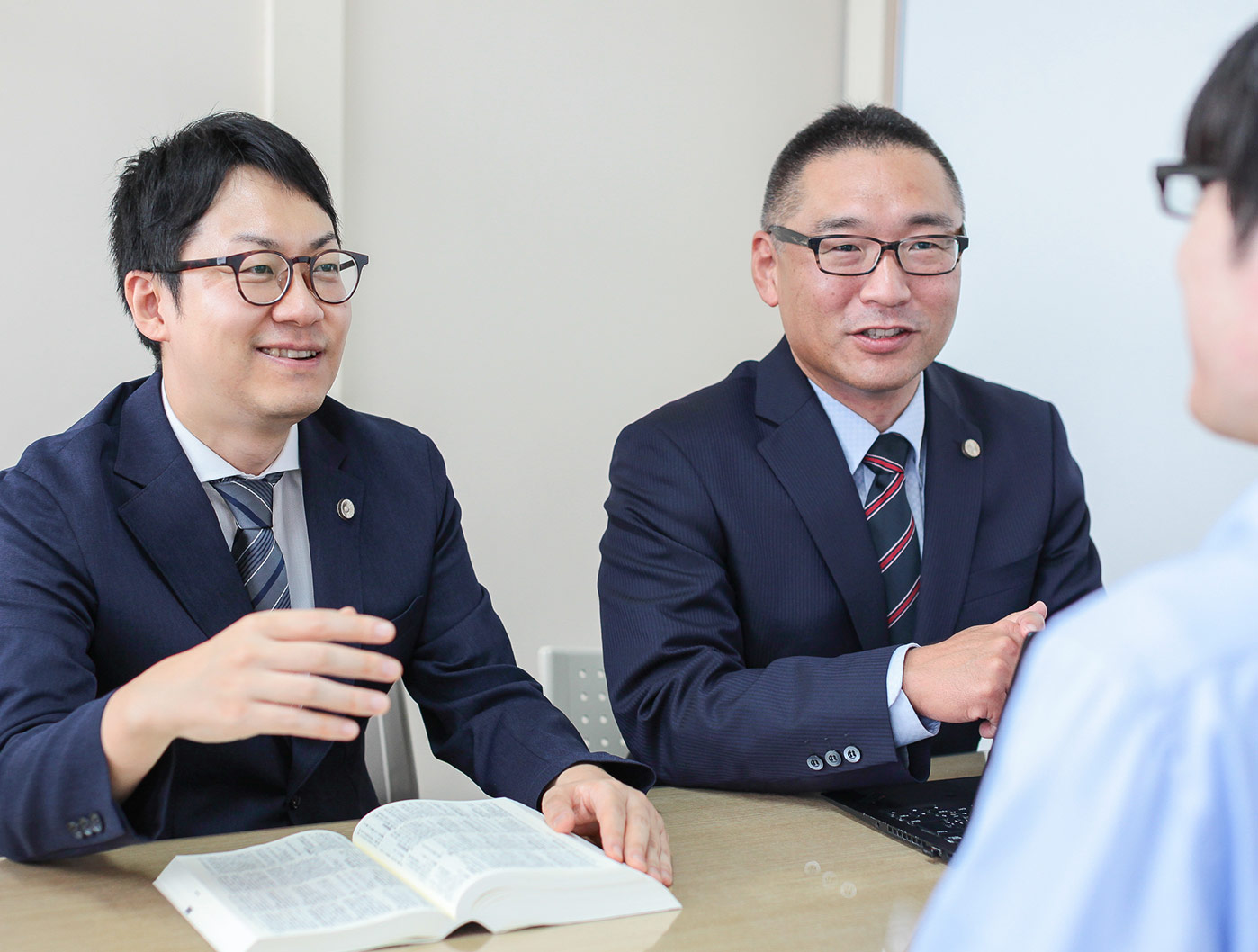
Reservation for Legal Consultation / Contact Us


Office
About Yaizu General Law Office
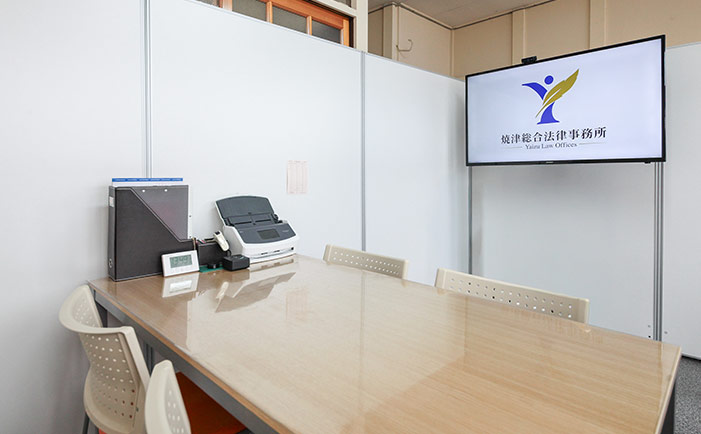
Yaizu Office
-
- Address
- 〒425-0028
3-11-4 Ekikita, Yaizu City,
Shizuoka Prefecture
-
- Phone
- 054-639-5573
-
- Business Hours
- Mon-Fri 9:00 AM - 7:00 PM Sat 9:00 AM - 5:00 PM / Closed: Sundays & Holidays
-
- Access
- 6-minute walk from Yaizu Station / Parking available
- Access
-
- Service Area
- Yaizu, Makinohara, Fujieda, Shimada, Yoshida, and surrounding areas


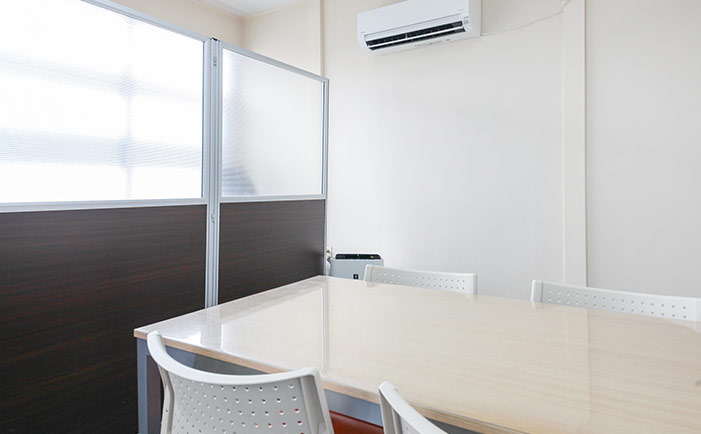
Makinohara Office
-
- Address
- 〒421-0422
Maison de Hautoku 1F, 140-4 Shizunami,
Makinohara City, Shizuoka Prefecture
-
- Phone
- 0548-28-6710
-
- Business Hours
- Mon-Fri 9:00 AM - 7:00 PM Sat 9:00 AM - 5:00 PM / Closed: Sundays & Holidays
-
- Access
- 4-minute walk from Shizunami 1-chome (Bus Stop) / Parking available
- Access
-
- Service Area
- Yaizu, Makinohara, Fujieda, Shimada, Yoshida, and surrounding areas




Flow
Free Legal Consultation Process
-
01

-
Making a Reservation for Free Legal Consultation
Please make a reservation by phone or email. There is absolutely no obligation to retain our services after a free consultation. If you are in need of help, please feel free to come in for a consultation.
02

-
Free Legal Consultation with an Attorney
An attorney will personally listen to the details of your situation. Bringing a memo or documents summarizing your issue will help the consultation go smoothly. If the matter is resolved through consultation alone, the process ends here.
03

-
If You Wish to Retain an Attorney
During the consultation, we will also explain the fees and outlook should we take on your case. If you wish to proceed, you may retain us at that time. You are also welcome to take the information home and consider it before making a decision.

