
Damages in Bicycle Accidents
Traffic Accidents


- Yaizu & Makinohara Attorneys Top
- Traffic Accidents
- Damages in Bicycle Accidents
- Want to consult about a traffic accident in the Yaizu, Yoshida, Makinohara, Fujieda, or Omaezaki area
- Was involved in an accident with a car while riding a bicycle
- Want to know if compensation can be claimed for injuries in a bicycle accident
- Want to file a damages claim for a bicycle-to-bicycle or bicycle-to-pedestrian accident
- Became the at-fault party in a bicycle accident and am concerned about handling the damages
Are you troubled by issues like these in Yaizu, Makinohara, Omaezaki, Fujieda, Shimada, Yoshida Town, or surrounding areas?
Yaizu Sogo Law Office offers a free initial legal consultation regarding traffic accident concerns. There is no obligation to retain our services after the initial consultation. We are also available on weekday evenings and Saturdays. Please feel free to contact us by phone or email.
Damages Claims Are Also an Issue in Bicycle Accidents

Bicycles are a familiar mode of transportation used daily for commuting, going to school, and shopping.
However, bicycle accidents can result in unexpectedly severe injuries and significant damages claims.
For example:
- Collided with a car while riding a bicycle
- Was hit by a bicycle while walking
- Fell after a collision between two bicycles
- A child injured a pedestrian while riding a bicycle
- Hit a car with a bicycle and was asked to pay for repairs
These are common scenarios.
Under the Road Traffic Act, bicycles are classified as "light vehicles" and must comply with certain traffic rules.
Therefore, in bicycle accidents, issues such as fault ratios, medical expenses, compensation for pain and suffering, lost income, residual disabilities, and insurance coverage may arise.
Furthermore, bicycles are not covered by the compulsory automobile liability insurance (CALI) system that applies to motor vehicles.
As a result, in bicycle accidents, the possibility of recovering damages can vary significantly depending on whether the at-fault party has insurance.
Main Types of Bicycle Accidents
The issues in bicycle accidents differ depending on the other party involved.
The main types include the following:
- Bicycle vs. automobile accidents
- Bicycle vs. motorcycle accidents
- Bicycle vs. pedestrian accidents
- Bicycle vs. bicycle accidents
- Bicycle vs. parked or stopped vehicle accidents
In some cases, the cyclist is the victim, while in others, the cyclist is the at-fault party.
In particular, in bicycle vs. pedestrian accidents, the cyclist may bear significant liability for damages.
Conversely, in bicycle vs. automobile accidents, the cyclist is more likely to sustain serious injuries, and issues of compensation for pain and suffering and residual disabilities tend to arise.
Bicycle vs. Automobile Accidents
In bicycle vs. automobile accidents, the cyclist is often the one who sustains injuries.
In such cases, the cyclist may be able to claim the following from the driver:
- Medical expenses
- Transportation costs for hospital visits
- Lost income
- Compensation for pain and suffering from hospitalization and outpatient treatment
- Compensation for pain and suffering from residual disabilities
- Lost future earnings due to residual disabilities
- Bicycle repair costs
- Damages for clothing and personal belongings
The cyclist may be able to claim these and other damages.
If the driver has voluntary automobile insurance, settlement negotiations are typically conducted with the other party's insurance company.
However, if the cyclist is also found to be at fault, the compensation amount will be reduced according to the fault ratio.
For example, if the cyclist is found to be 20% at fault, 20% will be deducted from the total damages.
In bicycle accidents, while the cyclist's status as a vulnerable road user is taken into consideration, factors such as running a red light, failing to stop, riding on the wrong side of the road, riding without lights at night, or using a smartphone while riding can significantly affect the fault ratio.
Bicycle vs. Pedestrian Accidents
In bicycle vs. pedestrian accidents, the cyclist is often the at-fault party.
Pedestrians are afforded particularly strong protection in traffic accident cases.
Therefore, when a cyclist collides with a pedestrian and causes injuries, the cyclist may be found to bear significant liability.
If the pedestrian suffers fractures, head injuries, or residual disabilities, the damages may range from several million to tens of millions of yen.
Even if the cyclist is a minor, the parents may be held liable on the grounds of a breach of supervisory duty.
For example, if a child on a bicycle collides with an elderly person and causes serious injuries, the parents may face a damages claim.
Bicycle accidents are often dismissed with the assumption that "it's not a car, so it can't be that serious," but it is important to be aware that causing serious injuries to a pedestrian can result in substantial liability.
Bicycle vs. Bicycle Accidents
In bicycle vs. bicycle accidents, both parties may sustain injuries or property damage.
In such cases, the degree of fault on each side is examined in the same manner as in automobile accidents.
For example:
- Intersection collisions
- Contact accidents on sidewalks
- Collisions caused by riding on the wrong side of the road
- Accidents caused by failure to stop
- Accidents while riding without lights at night
- Accidents while looking at a smartphone
In these cases, the fault ratio varies depending on the circumstances of the accident.
In bicycle vs. bicycle accidents, there are cases where the accident is not reported to the police or where there is little evidence of the accident circumstances.
Therefore, it is important to confirm the other party's name, address, and contact information immediately after the accident, and to take photographs of the accident scene and the damage to the bicycles.
Damages That Can Be Claimed in Bicycle Accidents
If you are injured in a bicycle accident, the main damages that can be claimed are as follows:
1. Medical Expenses
These are the costs necessary for treating injuries caused by the accident.
Medical expenses at hospitals, orthopedic clinics, and osteopathic clinics may become an issue.
However, the necessity and reasonableness of treatment at osteopathic and chiropractic clinics may be disputed.
It is important to continue treatment while being examined by a physician.
2. Transportation Costs for Hospital Visits
These are the transportation costs incurred for visiting the hospital.
Public transportation fares, gasoline costs for private vehicles, and taxi fares (when deemed necessary) may become an issue.
3. Lost Income
If you are unable to work due to injuries from the accident, you may be able to claim lost income.
The calculation method differs depending on whether you are a company employee, self-employed, or a homemaker.
4. Compensation for Pain and Suffering from Hospitalization and Outpatient Treatment
This is compensation for the emotional distress caused by hospitalization and outpatient treatment due to injuries.
It is calculated based on the treatment period, the actual number of outpatient visits, and the nature of the injuries.
5. Compensation for Residual Disability Pain and Suffering / Lost Future Earnings
If pain, numbness, limited range of motion, higher brain dysfunction, or other symptoms remain after the accident, the certification of a residual disability grade becomes an issue.
If a residual disability is certified, you may be able to claim compensation for pain and suffering and lost future earnings.
6. Property Damage
Damages for bicycle repair costs, replacement costs, helmets, clothing, smartphones, and other items may become an issue.
However, for property damage, the date of purchase, market value, and reasonableness of repairs may be disputed.
Compensation for Pain and Suffering in Bicycle Accidents
Even in bicycle accidents, you may be able to claim compensation for pain and suffering in the same manner as in automobile accidents.
Types of compensation for pain and suffering include:
- Compensation for pain and suffering from hospitalization and outpatient treatment
- Compensation for pain and suffering from residual disabilities
- Compensation for pain and suffering in the event of death
These are the main categories.
For example, if you collide with a car while riding a bicycle and suffer whiplash or fractures, you can claim compensation for pain and suffering based on the treatment period and the nature of the injuries.
Additionally, if residual disabilities remain, you may be able to claim compensation corresponding to the certified residual disability grade.
The amount of compensation offered by the insurance company may be lower than the court-standard amount.
If you receive a settlement proposal, it is important to verify whether the compensation amount is appropriate.
Fault Ratios in Bicycle Accidents
In bicycle accidents, fault ratios can be a major point of contention.
Fault ratios are determined on a case-by-case basis depending on the circumstances of the accident.
For example, in bicycle vs. automobile accidents, the driver's liability is often assessed more heavily; however, if the cyclist also committed traffic violations, the cyclist's fault may be increased.
Factors that commonly become issues as cyclist's fault include:
- Running a red light
- Failure to stop at a stop sign
- Riding on the wrong side of the road
- Riding without lights at night
- Riding with an umbrella
- Using a smartphone while riding
- Lack of awareness of surroundings due to earphone use
- Suddenly darting out
- Crossing outside a crosswalk
- High-speed riding on sidewalks
Even a small change in the fault ratio can significantly affect the final compensation amount.
For example, if the total damages amount to 5 million yen, a 10% change in the fault ratio results in a difference of 500,000 yen.
If you are not satisfied with the fault ratio proposed by the insurance company, it is necessary to carefully review the matter after examining the evidence related to the accident circumstances.
Can Insurance Be Used in Bicycle Accidents?
In bicycle accidents, it is extremely important to determine which insurance policies can be used.
In automobile accidents, compulsory automobile liability insurance (CALI) and voluntary insurance are typically at issue.
However, bicycles are not covered by the compulsory automobile liability insurance system that applies to motor vehicles.
Therefore, in bicycle accidents, the following types of insurance should be checked:
- Personal liability insurance
- Bicycle insurance
- Accident insurance
- Riders attached to fire insurance or automobile insurance
- Credit card-attached insurance
- Attorney's fee coverage rider
If you injure someone while riding a bicycle, personal liability insurance or bicycle insurance may be available.
Conversely, if you are the one who is injured, accident insurance, personal injury insurance, or an attorney's fee coverage rider may be applicable.
It is important to check your insurance policies and contract details early to determine whether any applicable coverage exists.
Verifying Bicycle Insurance Is Also Important in Shizuoka Prefecture
In bicycle accidents, if the at-fault party does not have insurance, there is a risk that the victim may not receive adequate compensation.
For this reason, there is a nationwide movement to promote enrollment in bicycle liability insurance and similar coverage.
The Ministry of Land, Infrastructure, Transport and Tourism has also published information on promoting enrollment in bicycle liability insurance.
When using a bicycle in Shizuoka Prefecture, it is also important to verify whether you are covered by bicycle insurance or personal liability insurance.
In particular, for families where children commute to school by bicycle, it is advisable to confirm that all family members are covered in case a pedestrian is injured.
Helmet Use and Its Impact on Damages
Following an amendment to the Road Traffic Act, as of April 1, 2023, wearing a helmet while riding a bicycle became an effort-based obligation for all cyclists. The National Police Agency also encourages all bicycle riders to wear helmets.
Not wearing a helmet does not immediately preclude a damages claim.
However, in accidents involving head injuries, whether the failure to wear a helmet contributed to the aggravation of damages may become a point of dispute.
In particular, in fatal accidents or accidents resulting in severe residual disabilities, the at-fault party may raise arguments related to comparative negligence or the duty to mitigate damages.
To prevent serious injuries in bicycle accidents, it is important to wear a helmet on a daily basis.
What to Do Immediately After a Bicycle Accident
If you are involved in a bicycle accident, the following steps are important:
Report the Accident to the Police
Even if you believe the accident is minor, always report it to the police.
Without a police report, you may be unable to obtain a traffic accident certificate later, which could hinder insurance claims and damages claims.
Visit a Hospital
Even if the pain is mild immediately after the accident, symptoms may worsen later.
In particular, if you experience neck or back pain, headaches, numbness, or dizziness, it is important to visit a medical facility promptly.
Confirm the Other Party's Information
Confirm the other party's name, address, phone number, employer, insurance company, and vehicle registration number.
In bicycle vs. bicycle or bicycle vs. pedestrian accidents, the other party may leave the scene, so be sure to obtain their contact information.
Preserve Evidence
It is important to preserve photographs of the accident scene, traffic signals, stop signs, road conditions, damage to bicycles and vehicles, and injuries.
Also check for dashcam footage, security camera footage, and witnesses.
When You Are the At-Fault Party in a Bicycle Accident
In bicycle accidents, you or your family member may become the at-fault party.
In particular, if you injure a pedestrian, you may face substantial damages claims for medical expenses, compensation for pain and suffering, lost income, and lost future earnings due to residual disabilities.
If you become the at-fault party, first check your insurance coverage.
Personal liability insurance, bicycle insurance, and riders attached to fire insurance or automobile insurance may be applicable.
Additionally, you should avoid making hasty payment promises or drafting settlement agreements at the scene with the victim.
Making commitments before the damages amount and fault ratio are determined may lead to disputes later.
We recommend consulting with your insurance company or an attorney to handle the situation.
Benefits of Consulting an Attorney for Bicycle Accidents
In bicycle accidents, consulting an attorney can be beneficial in the following situations:
- The compensation amount offered by the insurance company is too low
- You are not satisfied with the proposed fault ratio
- You are likely to have residual disabilities from a bicycle accident
- The at-fault party does not have insurance, and you are concerned about recovering damages
- Negotiations are not progressing in a bicycle vs. bicycle accident
- Your child caused a bicycle accident, and you are facing a damages claim
- You were hit by a bicycle as a pedestrian, and the other party's response is unsatisfactory
By consulting an attorney, you can organize the damages amount, fault ratio, availability of insurance, and the likelihood of recovery.
Additionally, if an attorney's fee coverage rider is available, you may be able to consult and retain an attorney with reduced out-of-pocket costs.
Summary

In bicycle accidents, damages such as medical expenses, compensation for pain and suffering, lost income, residual disabilities, and property damage may become issues.
In bicycle vs. automobile accidents, the cyclist is more likely to sustain serious injuries, and compensation for pain and suffering and residual disabilities become important.
On the other hand, in bicycle vs. pedestrian accidents, the cyclist may bear significant liability for damages as the at-fault party.
Furthermore, since bicycles are not covered by compulsory automobile liability insurance, it is important to verify bicycle insurance, personal liability insurance, accident insurance, and attorney's fee coverage riders.
If you have been involved in a bicycle accident or have caused one, we recommend promptly reporting it to the police, preserving evidence, and confirming your insurance coverage and damages response.
Frequently Asked Questions
Can I claim compensation for pain and suffering in a bicycle accident?
You may be able to in certain cases. If you are injured in a bicycle accident, you can claim compensation for pain and suffering from hospitalization and outpatient treatment based on the treatment period and the nature of the injuries. If residual disabilities remain, compensation for residual disability pain and suffering may also become an issue.
Can I receive a residual disability certification for a bicycle accident?
In cases involving an automobile where compulsory automobile liability insurance applies, residual disability grade certification may become an issue. Even in bicycle vs. bicycle or bicycle vs. pedestrian accidents, the presence or absence of residual disabilities significantly affects the damages amount.
In a bicycle vs. pedestrian accident, is the cyclist always at fault?
Pedestrians are strongly protected as vulnerable road users, and the cyclist's liability is often assessed more heavily. However, the fault ratio may vary depending on individual circumstances, such as a pedestrian suddenly darting out.
If a child causes a bicycle accident, are the parents liable?
Parents may be held liable on the grounds of a breach of supervisory duty. In particular, if serious injuries are caused to a pedestrian, substantial damages may become an issue.
What types of insurance can be used for bicycle accidents?
Personal liability insurance, bicycle insurance, accident insurance, riders attached to fire insurance or automobile insurance, and attorney's fee coverage riders may be applicable in certain cases. First, check your insurance policies.
Can an attorney's fee coverage rider be used for bicycle accidents?
It may be available in certain cases. An attorney's fee coverage rider attached to automobile insurance or fire insurance may also be applicable to bicycle accidents.
Do I need to report a bicycle accident to the police?
Yes, you do. Even if you believe the accident is minor, you may later need a traffic accident certificate or need to file an insurance claim, so we recommend always reporting it to the police.
What happens if the other party in a bicycle accident does not have insurance?
You will need to claim directly against the other party. However, the other party's ability to pay may be an issue. It is also important to check whether your own insurance or attorney's fee coverage rider can be used.
The Initial Legal Consultation for Traffic Accidents at Yaizu Sogo Law Office Is Free of Charge
Yaizu Sogo Law Office provides a free initial legal consultation regarding traffic accidents.
We handle all traffic accident-related legal matters, regardless of severity or whether they involve property damage or personal injury. If you are feeling stressed by dealings with insurance companies, or if you want to know whether the amount offered by your insurance company is fair, please do not hesitate to consult with us.
Yaizu Sogo Law Office is available not only during regular weekday hours but also on weekday evenings and Saturdays. Please contact us by phone or email to schedule a legal consultation.
Contact
If you are facing issues with traffic accidents, debt restructuring, or inheritance:You can consult a lawyer for free
At Yaizu General Law Office, free legal consultations are available for those facing traffic accidents, debt restructuring, or inheritance issues. There is no obligation to retain our services after a free consultation. For other areas of law, consultations are available at 5,500 yen (tax included) per 30 minutes. Please do not hesitate to contact us if you need assistance.
Reservation for Legal Consultation / Contact Us


Office
About Yaizu General Law Office
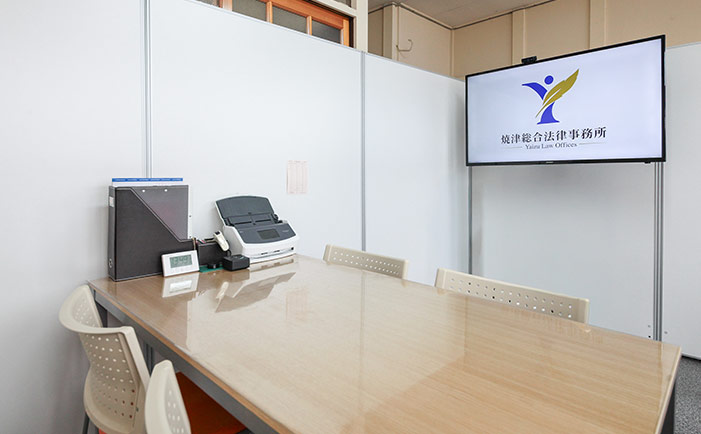
Yaizu Office
-
- Address
- 〒425-0028
3-11-4 Ekikita, Yaizu City,
Shizuoka Prefecture
-
- Phone
- 054-639-5573
-
- Business Hours
- Mon-Fri 9:00 AM - 7:00 PM Sat 9:00 AM - 5:00 PM / Closed: Sundays & Holidays
-
- Access
- 6-minute walk from Yaizu Station / Parking available
- Access
-
- Service Area
- Yaizu, Makinohara, Fujieda, Shimada, Yoshida, and surrounding areas


Makinohara Office
-
- Address
- 〒421-0422
Maison de Hautoku 1F, 140-4 Shizunami,
Makinohara City, Shizuoka Prefecture
-
- Phone
- 0548-28-6710
-
- Business Hours
- Mon-Fri 9:00 AM - 7:00 PM Sat 9:00 AM - 5:00 PM / Closed: Sundays & Holidays
-
- Access
- 4-minute walk from Shizunami 1-chome (Bus Stop) / Parking available
- Access
-
- Service Area
- Yaizu, Makinohara, Fujieda, Shimada, Yoshida, and surrounding areas




Flow
Free Legal Consultation Process
-
01

-
Making a Reservation for Free Legal Consultation
Please make a reservation by phone or email. There is absolutely no obligation to retain our services after a free consultation. If you are in need of help, please feel free to come in for a consultation.
02

-
Free Legal Consultation with an Attorney
An attorney will personally listen to the details of your situation. Bringing a memo or documents summarizing your issue will help the consultation go smoothly. If the matter is resolved through consultation alone, the process ends here.
03

-
If You Wish to Retain an Attorney
During the consultation, we will also explain the fees and outlook should we take on your case. If you wish to proceed, you may retain us at that time. You are also welcome to take the information home and consider it before making a decision.

