
Can a Car Proceed if a Pedestrian Yields at a Crosswalk?
Traffic Accidents


- Yaizu & Makinohara Attorneys Top
- Traffic Accidents
- Can a Car Proceed if a Pedestrian Yields at a Crosswalk?
- I want to consult a lawyer in the Yaizu, Yoshida, Makinohara, Fujieda, or Omaezaki area
- A pedestrian signaled "go ahead" at an unsignalized crosswalk, but I want to know if it is okay for the car to proceed first
- I proceeded after a pedestrian yielded to me, but the police said it was a violation for obstructing pedestrians at a crosswalk
- I want to know in what situations I must stop when there are pedestrians near a crosswalk
- I want to know how fault is allocated if a traffic accident occurs with a pedestrian at a crosswalk
Are you troubled by issues like these in Yaizu, Makinohara, Omaezaki, Fujieda, Shimada, Yoshida Town, or surrounding areas?
Yaizu Sogo Law Office offers a free initial legal consultation regarding traffic accident concerns. There is no obligation to retain our services after the initial consultation. We are also available on weekday evenings and Saturdays. Please feel free to contact us by phone or email.
Introduction
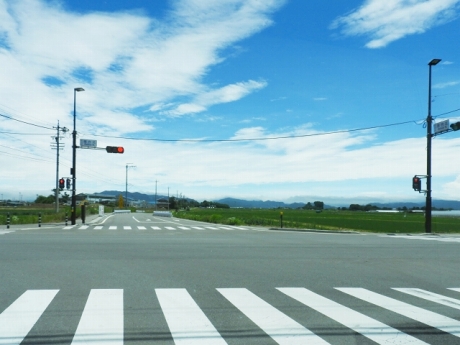
You were approaching a crosswalk without traffic signals and noticed a pedestrian about to cross, so you stopped your car. However, the pedestrian waved their hand as if to say, "Go ahead."
Many drivers have probably had this kind of experience.
In particular, pedestrians accompanied by children or elderly individuals may yield to cars because they feel it would be dangerous to rush across the road.
So, if a pedestrian voluntarily signals "go ahead," is it permissible for the car to pass through the crosswalk first?
This issue cannot be resolved simply by thinking, "The pedestrian gave permission, so it's fine."
Article 38 of the Road Traffic Act requires vehicles to stop immediately before a crosswalk and not obstruct the passage of pedestrians when there are pedestrians crossing or "about to cross" the crosswalk. The National Police Agency has also clearly stated that pedestrians have priority at crosswalks.
However, careful judgment is required as to whether a violation of Article 38 of the Road Traffic Act always occurs even in situations where a pedestrian has clearly withdrawn their intention to cross and is asking the car to go first.
This article explains the traffic rules when a pedestrian signals "go ahead" at an unsignalized crosswalk, the details of the violation for obstructing pedestrians at crosswalks, how to respond safely in actual driving situations, and the liability if an accident occurs.
"Pedestrian Priority" Is the Principle at Crosswalks
As a fundamental premise, pedestrians have priority at crosswalks.
Article 38, Paragraph 1 of the Road Traffic Act establishes two levels of obligations for vehicles approaching a crosswalk or bicycle crossing.
The first obligation is to proceed at a speed that allows the vehicle to stop immediately before the crosswalk, unless it is "clearly evident that there are no pedestrians about to cross."
In other words,
- "I cannot tell whether there are pedestrians"
- "There is someone standing beside the crosswalk"
- "The view is obstructed by buildings or parked vehicles and I cannot confirm the presence of pedestrians"
In such cases, you may not simply maintain your speed and enter the crosswalk.
You must slow down to a speed that allows you to stop before the crosswalk.
The second obligation is that, when there are pedestrians actually crossing or about to cross the crosswalk, you must stop immediately before the crosswalk and must not obstruct their passage.
The Shizuoka Prefectural Police also advises that when approaching a crosswalk, drivers should proceed at a speed that allows them to stop immediately before it unless it is clearly evident that no pedestrians are present, and that they must stop and not obstruct passage when pedestrians are about to cross.
Therefore,
"The pedestrian hasn't stepped onto the crosswalk yet, so I can proceed"
is an incorrect way of thinking.
Even if the pedestrian has not yet entered the roadway, they are protected if they are "a pedestrian about to cross."
Can a Car Proceed if a Pedestrian Signals "Go Ahead"?
So, in a case like this one, where a car has stopped and a pedestrian clearly waves their hand to indicate "please go ahead," what happens?
The most important question in this case is whether the pedestrian remains in a state that qualifies as "a pedestrian about to cross" under Article 38 of the Road Traffic Act.
It is not the case that a car must remain stopped indefinitely in every situation simply because a pedestrian is standing in front of a crosswalk.
For example, if a person is standing near a crosswalk but has no intention of crossing and is simply waiting for someone, they would not typically be considered "a pedestrian about to cross."
Similarly, if a pedestrian initially intended to cross but clearly indicated to the car, "Please go ahead," and showed an intention not to begin crossing, whether they still qualify as "a pedestrian about to cross" at that point must be determined based on the specific circumstances.
Therefore, it is not appropriate to simplify the matter to the point of saying, "Even if a pedestrian yields, the car must absolutely never proceed."
On the other hand, from the driver's perspective,
- "Has the pedestrian truly withdrawn their intention to cross?"
- "Did they simply wave out of courtesy?"
- "Is there a possibility that a child might suddenly start crossing?"
It is dangerous to start moving the car while these questions remain unclear.
Not only from the standpoint of obligations under the Road Traffic Act, but also from the perspective of preventing traffic accidents, the basic response when a pedestrian's intentions are ambiguous is to let the pedestrian cross first.
"The Pedestrian Gave Permission, So It's Not a Violation" Is Not Necessarily True
It is important to note that the obligation under Article 38 of the Road Traffic Act is not merely a "rule of mutual yielding" between pedestrians and drivers.
For example, it is different from a situation in a private parking lot where someone says, "I'll wait, so please go ahead."
The Road Traffic Act regulates drivers' behavior to ensure safety on roads.
Therefore, the mere fact that a pedestrian made some kind of gesture does not automatically eliminate the driver's obligations under the Road Traffic Act.
In particular,
- The pedestrian is standing right in front of the crosswalk
- Their body is facing the direction of the crosswalk
- They have already stepped forward with one foot
- A child is trying to move ahead
- There are multiple pedestrians and only some of them are signaling
Caution is required in such cases.
For example, even if a parent with three family members standing in front of a crosswalk waves to say "go ahead," if a child beside them is about to step onto the road, it would be extremely dangerous for the car to proceed.
Additionally, it is possible for a driver to interpret a pedestrian's hand movement as meaning "I want the car to go first" based on their own assumption.
As long as there is an objective possibility that the pedestrian still intends to cross, it is safer to avoid proceeding simply because "it looked like they yielded."
What Is the Safest Response for Drivers?
In actual driving, it is not recommended to make borderline legal judgments such as "this pedestrian no longer intends to cross, so I can proceed."
When there is a pedestrian in front of a crosswalk, the basic approach is to stop first and let the pedestrian cross.
Even if a pedestrian signals "go ahead," do not immediately press the accelerator; instead, observe the pedestrian's behavior.
For example, if the pedestrian clearly steps back from the crosswalk and again signals the car to proceed, indicating a clear intention not to begin crossing, it may be possible to confirm their intention and proceed after ensuring sufficient safety.
However, if there is even the slightest doubt in your judgment, it is safer for the car to wait.
When there are vehicles behind you, you might think, "I should hurry so I don't inconvenience them."
However, the safety of pedestrians at crosswalks should take priority over consideration for vehicles behind you.
What Is the Penalty for Obstructing Pedestrians at Crosswalks?
A violation of Article 38 of the Road Traffic Act constitutes a traffic violation known as "obstruction of pedestrians at crosswalks, etc."
According to the National Police Agency, the current administrative fines are:
| Large vehicles | 12,000 yen |
|---|---|
| Standard vehicles | 9,000 yen |
| Motorcycles | 7,000 yen |
| Mopeds | 6,000 yen |
| Bicycles | 6,000 yen |
The base demerit points for motor vehicles are 2 points.
Additionally, the penalty under the Road Traffic Act includes imprisonment for up to 3 months or a criminal fine of up to 50,000 yen.
For a standard passenger car, the amount of "9,000 yen" refers to this administrative fine.
Note that an administrative fine (hansokukin) is different from a criminal "fine" (bakkin).
Under the traffic violation notification system, if the prescribed administrative fine is paid according to the designated procedure, no criminal prosecution will be filed.
Therefore, although it is sometimes referred to as a "9,000 yen fine," the accurate term for a standard vehicle is an "administrative fine of 9,000 yen."
Once You Stop, Can You Freely Proceed Afterward?
This is also a common misconception.
Article 38 of the Road Traffic Act does not simply require "stopping once in front of the crosswalk."
In addition to stopping temporarily, you are required to "not obstruct the passage of pedestrians."
Therefore, even if you stopped once, starting your car to cross in front of a pedestrian who is trying to cross could be problematic.
For example,
You spot a pedestrian and stop
↓
The pedestrian begins to cross
↓
You decide, "They haven't reached my lane yet, so it's fine," and proceed
This type of response should be avoided.
On wide roads in particular, drivers may think, "The pedestrian is still on the opposite lane side, so I can go first."
However, Article 38 of the Road Traffic Act requires that you not obstruct the passage of pedestrians.
The basic principle is to drive in a way that does not cause pedestrians to stop or change their walking speed out of caution toward your car.
Must You Always Slow Down if There Are Pedestrians Near a Crosswalk?
Article 38 of the Road Traffic Act provides that, unless it is "clearly evident that there are no pedestrians about to cross," you must proceed at a speed that allows you to stop immediately before the crosswalk.
This is not a rule that says, "You only need to brake after you spot a pedestrian."
For example, if there are buildings, utility poles, parked vehicles, or other obstructions near the crosswalk that make it difficult to confirm whether pedestrians are present, it cannot be said that "it is clearly evident that there are no pedestrians."
In such cases, you must slow down enough to stop immediately before the crosswalk if a pedestrian appears.
The diamond-shaped "diamond marks" painted on the road are road markings indicating that there is a crosswalk or bicycle crossing ahead.
When you see diamond marks while driving, checking for the presence of pedestrians near the crosswalk at an early stage will help prevent traffic accidents.
Caution Is Also Needed at Crosswalks Where Oncoming Vehicles Are Stopped
At crosswalks, it is not sufficient to check only your own lane side.
For example, if an oncoming vehicle has stopped in front of a crosswalk, a pedestrian may be crossing from behind that vehicle.
Additionally, Article 38, Paragraph 2 of the Road Traffic Act provides that when a vehicle is stopped at or before a crosswalk, you must stop temporarily before passing alongside that vehicle and proceeding forward.
"I don't know why the car ahead is stopped"
In such a situation, it is especially dangerous to proceed by overtaking from the side.
You must drive cautiously, considering the possibility that a pedestrian may be hidden behind the stopped vehicle.
Extra Caution Is Required at Crosswalks Where Children Are Present
In cases like this one, where a pedestrian is accompanied by children, even more careful driving is necessary.
Even if an adult signals "go ahead," a child may not understand what that means.
Even though the adult intends to wait, a child may suddenly dash onto the crosswalk.
Additionally, Article 71 of the Road Traffic Act contains provisions for protecting the passage of children, infants, and similar persons.
Regardless of how far the law permits you to proceed, you need to drive with the assumption that children's movements are unpredictable.
In particular,
- Near nurseries or schools
- During school commute hours
- In residential areas
- Near parks
- At crosswalks with poor visibility
It is important to proceed at a speed that allows you to stop immediately.
What Happens if You Cause an Accident with a Pedestrian at a Crosswalk?
If you proceed at a crosswalk where a pedestrian is present and cause a traffic accident, it may not only constitute a traffic violation but also give rise to civil liability for damages and criminal liability.
In the civil allocation of fault for traffic accidents, pedestrians on crosswalks are strongly protected.
However,
"It's a crosswalk, so the car is always 100% at fault"
is not determined mechanically.
It must be examined based on specific accident circumstances, including the presence or color of traffic signals, the location of the accident, the pedestrian's manner of crossing, and the vehicle's progress.
In relation to this article's topic,
"The pedestrian signaled the car to go first"
Even if such a circumstance existed, it is better not to assume that the driver's liability is automatically eliminated by that fact alone.
Drivers have a duty to confirm the safety of their surroundings while driving.
Especially when children or elderly individuals are present, the fact that "I proceeded because the pedestrian yielded" does not by itself constitute sufficient safety confirmation.
If the allocation of fault becomes an issue after an accident, dashcam footage can serve as extremely important evidence.
This is because it allows objective confirmation of where the pedestrian was, what kind of signal they gave, whether the car stopped temporarily, and what the speed was at the time of departure.
To Prevent Traffic Accidents at Crosswalks
At unsignalized crosswalks, communication between pedestrians and cars about who should go first sometimes breaks down.
There are also situations where a car stops but the pedestrian also stands still, resulting in a state of mutual yielding.
However, the basic rule is clear.
If there is a pedestrian about to cross, the car must stop and let the pedestrian pass first.
Near crosswalks, it is important to drive not only considering "whether it is legally permissible to proceed" but also "whether I can respond safely if the pedestrian suddenly starts moving."
Summary

Pedestrian priority at crosswalks is the basic rule, but in actual traffic accidents,
- "Was the pedestrian really about to cross?"
- "Did the car stop temporarily?"
- "Did the pedestrian signal the car to go ahead?"
- "How were both parties moving immediately before the accident?"
Such detailed factual issues can become relevant.
Additionally, when a traffic accident occurs, whether there was a violation of the Road Traffic Act and the civil allocation of fault must each be examined separately.
The fault allocation proposed by the insurance company is not necessarily appropriate in light of the accident circumstances.
Yaizu General Law Office handles traffic accident consultations primarily in Yaizu City, Fujieda City, Makinohara City, Shimada City, Yoshida Town, Omaezaki City, and surrounding areas.
If you were involved in a traffic accident at a crosswalk, cannot reach an agreement with the other party's insurance company on fault allocation, or are unsure how to evaluate your dashcam footage, please consider consulting a lawyer when the situation is difficult to handle on your own.
FAQ
If a pedestrian says "go ahead," is it always a violation for the car to proceed first?
It is not necessarily always a violation.
Article 38 of the Road Traffic Act applies to pedestrians who are "crossing or about to cross" a crosswalk.
Whether a pedestrian who has clearly indicated an intention not to begin crossing still qualifies as "a pedestrian about to cross" depends on the specific circumstances.
However, when the pedestrian's intention is ambiguous, it is safer for the car to wait and let the pedestrian cross first.
Is it okay if I stop once and then proceed after a pedestrian yields to me?
Simply having stopped temporarily does not automatically mean it is okay.
Article 38 of the Road Traffic Act requires not only stopping temporarily but also not obstructing the passage of pedestrians.
If a pedestrian is trying to cross, the car should avoid passing in front of them.
Must I always stop if someone is standing in front of a crosswalk?
If that person is crossing or about to cross, you must stop temporarily.
On the other hand, if the person is clearly not intending to cross, such as when they are simply waiting for someone near the crosswalk, the obligation to stop does not uniformly apply.
However, if you cannot determine whether the person intends to cross, you must slow down to a speed that allows you to stop immediately before the crosswalk.
What are the administrative fine and demerit points for obstructing pedestrians at crosswalks?
For a standard vehicle, the administrative fine is 9,000 yen and the base demerit points are 2 points.
Although it is sometimes referred to as a "9,000 yen fine," the 9,000 yen paid under the traffic violation notification system is technically an "administrative fine" (hansokukin), not a criminal "fine" (bakkin).
What should I do if the pedestrian won't cross despite my stopping?
First, stop and observe the pedestrian's movements.
There may be cases where the pedestrian clearly indicates they want the car to go first, but it is safer to avoid starting the car when their intention is unclear.
Especially when children, elderly individuals, or multiple pedestrians are present, please respond cautiously considering the possibility that someone may suddenly begin to cross.
If a pedestrian says "go ahead" and an accident occurs afterward, does the pedestrian bear any responsibility?
The fact that a signal was given may be considered as one factor in examining the accident circumstances, but it does not by itself eliminate the driver's liability.
The actual fault allocation is determined on a case-by-case basis, taking into account the crosswalk conditions, traffic signals, the relative positions of the pedestrian and vehicle, speed, and the movements of both parties.
It is important to preserve dashcam footage from the time of the accident.
I am not satisfied with the fault allocation proposed by the insurance company regarding an accident at a crosswalk. What should I do?
Fault allocation is not something that is simply decided by the insurance company.
It is examined after confirming the accident circumstances, taking into account the obligations under the Road Traffic Act and past court precedents.
The evaluation of the accident circumstances may change based on dashcam footage, on-scene investigation reports, security camera footage, and photos of the scene.
If you have doubts about the proposed fault allocation, please consider consulting a lawyer before agreeing to a settlement.
The Initial Legal Consultation for Traffic Accidents at Yaizu Sogo Law Office Is Free of Charge
Yaizu Sogo Law Office provides a free initial legal consultation regarding traffic accidents.
We handle all traffic accident-related legal matters, regardless of severity or whether they involve property damage or personal injury. If you are feeling stressed by dealings with insurance companies, or if you want to know whether the amount offered by your insurance company is fair, please do not hesitate to consult with us.
Yaizu Sogo Law Office is available not only during regular weekday hours but also on weekday evenings and Saturdays. Please contact us by phone or email to schedule a legal consultation.
Contact
If you are facing issues with traffic accidents, debt restructuring, or inheritance:You can consult a lawyer for free
At Yaizu General Law Office, free legal consultations are available for those facing traffic accidents, debt restructuring, or inheritance issues. There is no obligation to retain our services after a free consultation. For other areas of law, consultations are available at 5,500 yen (tax included) per 30 minutes. Please do not hesitate to contact us if you need assistance.
Reservation for Legal Consultation / Contact Us


Office
About Yaizu General Law Office
Yaizu Office
-
- Address
- 〒425-0028
3-11-4 Ekikita, Yaizu City,
Shizuoka Prefecture
-
- Phone
- 054-639-5573
-
- Business Hours
- Mon-Fri 9:00 AM - 7:00 PM Sat 9:00 AM - 5:00 PM / Closed: Sundays & Holidays
-
- Access
- 6-minute walk from Yaizu Station / Parking available
- Access
-
- Service Area
- Yaizu, Makinohara, Fujieda, Shimada, Yoshida, and surrounding areas


Makinohara Office
-
- Address
- 〒421-0422
Maison de Hautoku 1F, 140-4 Shizunami,
Makinohara City, Shizuoka Prefecture
-
- Phone
- 0548-28-6710
-
- Business Hours
- Mon-Fri 9:00 AM - 7:00 PM Sat 9:00 AM - 5:00 PM / Closed: Sundays & Holidays
-
- Access
- 4-minute walk from Shizunami 1-chome (Bus Stop) / Parking available
- Access
-
- Service Area
- Yaizu, Makinohara, Fujieda, Shimada, Yoshida, and surrounding areas




Flow
Free Legal Consultation Process
-
01

-
Making a Reservation for Free Legal Consultation
Please make a reservation by phone or email. There is absolutely no obligation to retain our services after a free consultation. If you are in need of help, please feel free to come in for a consultation.
02

-
Free Legal Consultation with an Attorney
An attorney will personally listen to the details of your situation. Bringing a memo or documents summarizing your issue will help the consultation go smoothly. If the matter is resolved through consultation alone, the process ends here.
03

-
If You Wish to Retain an Attorney
During the consultation, we will also explain the fees and outlook should we take on your case. If you wish to proceed, you may retain us at that time. You are also welcome to take the information home and consider it before making a decision.

